
I wish all my ambitious friends would read Moby Dick
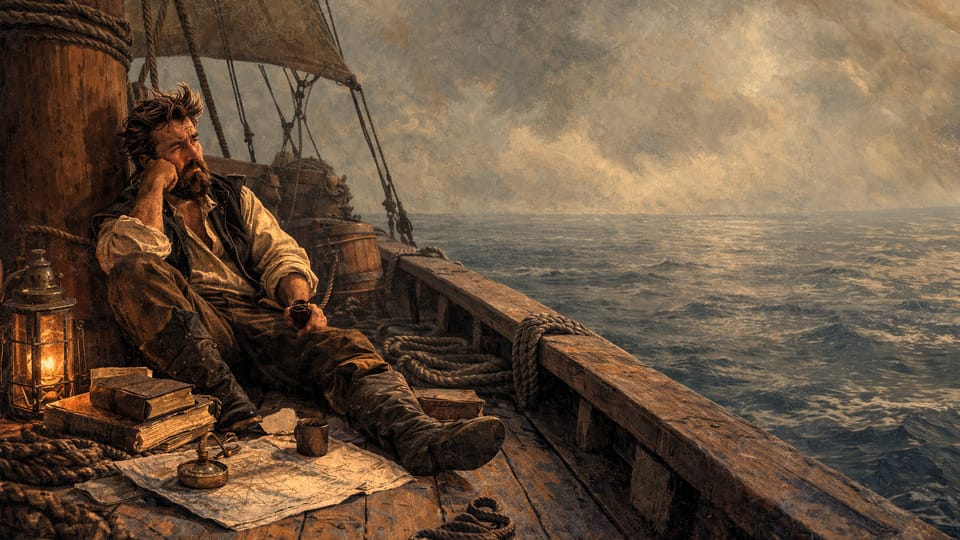
Saying Moby Dick is about a captain obsessed with catching a whale is like saying Crime and Punishment is about a double ax murder. While technically correct, it completely misses the point.
The first ~100 pages of of Moby Dick are exciting. We get to meet all the characters we get on the ship, we hear about the mysterious Ahab, and we set off to sea for a long journey.
The next 600 pages are extremely boring. You will learn more about mid 1800's whaling than you ever wanted to learn. It's closer to an encyclopedia about the types of whale anatomy, taxonomy, whale oil, blubber processing, and the history of whaling. This goes on for far longer than you or anyone wants, it will make you ask why this book exists, why it's a classic, and what's the point of it all?
Non-fiction can't do this
You can read every popular non-fiction book around how important it is to be obsessed about your goals and none will be as compelling as Moby Dick. The hunt for the white whale doesn't tell you to be obsessed - it forces you to experience Ahab's obsession for yourself.
The voyage in Moby Dick takes place across 3 years. The book takes a few weeks to read to simulate the endless dead black sea that the sailors felt. The dangerous nights and boring uncomfortable days, the long hunting days with no reward, and an infuriating vast nothingness. When you read weeks of this you don't just get the message, you share the experience - you will be truly bored and frustrated, you will want to quit.
Then in only the last ~10 pages the white whale appears and things go full throttle. Despite years of boredom we find that Ahab's focus is completely undeterred, he has not been whaling for profit, he is only here to get revenge from the whale who took his leg. Only a person with a soul of immense determination could sit idle for so long and still be so vigilant to spring into pure action when called.
"Swerve me? The path to my fixed purpose is laid with iron rails, whereon my soul is grooved to run. Over unsounded gorges, through the rifled hearts of mountains, under torrents' beds, unerringly I rush! Naught's an obstacle, naught's an angle to the iron way!" - Ahab
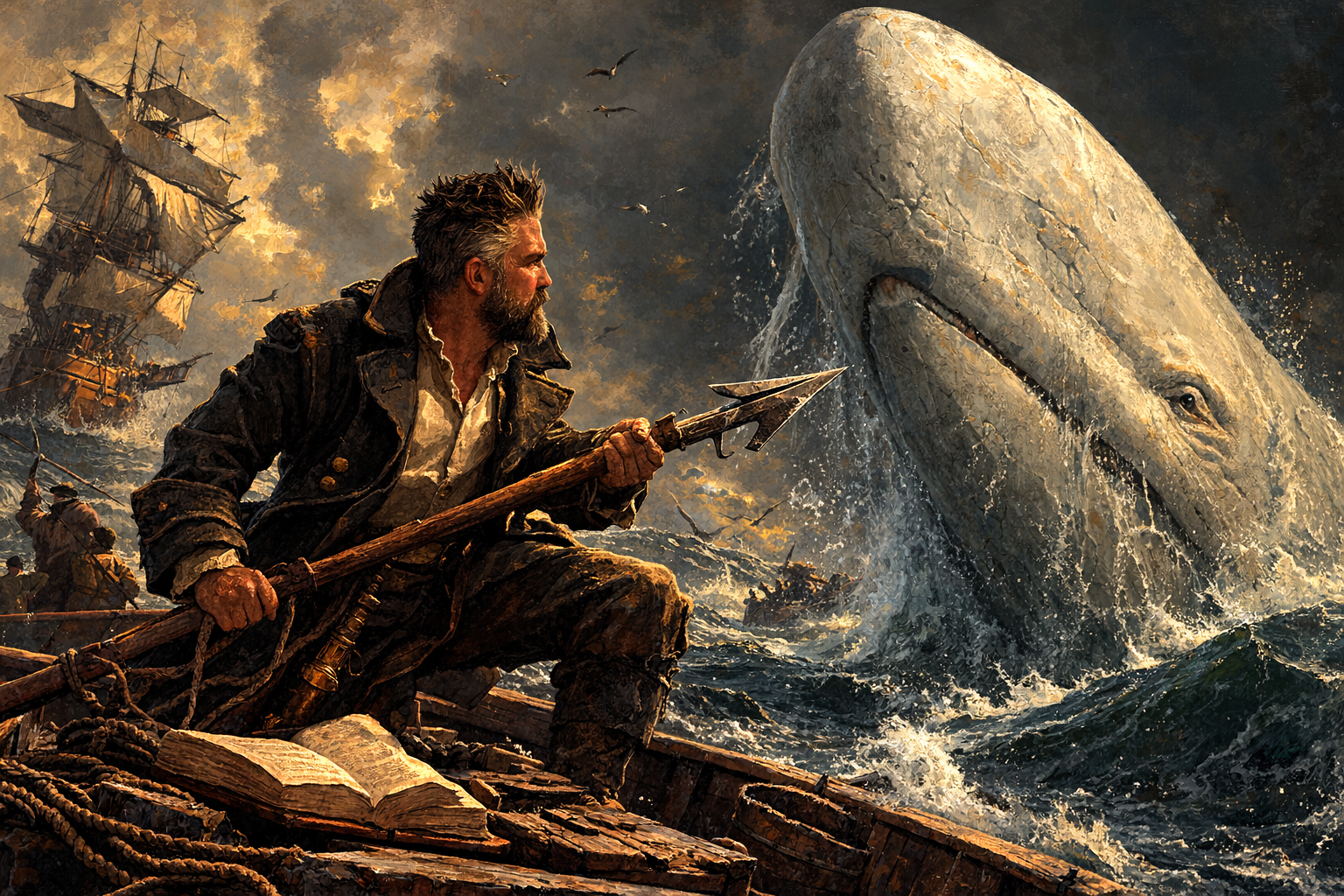
Choose your temple of fanaticism with great care
Moby Dick is two lessons.
The first is to understand how large of a commitment is demanded to reach their obsession. A person must be patient for unnervingly long periods of time and then be able to explode with their entire being into this one aim in order to even attempt to catch the uncatchable.
"But, as in his narrow-flowing monomania, not one jot of Ahab's broad madness had been left behind; so in that broad madness, not one jot of his great natural intellect had perished. That before living agent, now became the living instrument. If such a furious trope may stand, his special lunacy stormed his general sanity, and carried it, and turned all its concentred cannon upon its own mad mark; so that far from having lost his strength, Ahab, to that one end, did now possess a thousand fold more potency than ever he had sanely brought to bear upon any one reasonable object."
The second lesson is to choose the correct obsession. Ahab sort of enacted the right behavior but he did it in the wrong way. Ahab places all his internal and spiritual malice onto the whale - you don't create a goal through anger and destruction, and you don't expect the world to change because you killed a whale - it's just a whale. Killing it will not end the worlds suffering and it won't bring Ahab's leg back.
In the very last few pages Ahab finds Moby Dick and goes to unthinkable and unreasonable lengths to kill him. The ship quickly gets rammed by the whale and sinks with Ahab and the entire crew attached (except Ishmael, the narrator). Moby Dick lives on completely indifferent to the experience.
Death is the obvious and only end to a person who is willing to die for their obsession when their obsession contains impossible outcomes and expectations.

Why do I want you to read this?
I used to think that "fiction is just stories, non-fiction is for learning" and I find this is a common sentiment for others to share. I was very wrong, and if you think this so are you.
Non-fiction tells you what someone else thinks and you can decide if you agree, but fiction doesn't tell you its lesson - it forces you to figure it out for yourself. Your brain has to work much harder to understand and tinker and wrestle with the material and then you're forced to have your own opinion about it. Secondly, non-fiction gives you information while fiction (well written fiction) gives you experiences. For example, which lesson is likelier to stick in your brain, your dad telling you not to touch the stove or you touching the stove and having the experience yourself. Fiction is much closer to the latter.
For these reasons, I can't embed this lesson in you anymore than the pile of non-fiction books that I mentioned earlier which would try to do the same. I write this as an encouragement to go earn these lessons for yourself as it cannot be transferred with mere summaries.
Lastly, I wonder that if a person can't stomach a long book - what chance do they have to reach their highest goals? I guarantee the voyage toward your obsession is far more daunting than reading a book. In this way Moby Dick acts as a test of your resolve.
Member discussion